Most small businesses run sales from a mix of memory, spreadsheets and phone contacts. It works, right up until it doesn’t: leads go cold because nobody followed up, the owner is the only person who knows why a deal stalled, and when a key salesperson leaves, half the customer relationships walk out with them. A CRM fixes all of this — but only if it’s actually used, and only if it connects to the rest of how you run the business.
This guide explains what customer relationship management really is, how to tell you’ve outgrown your current setup, and how to adopt a CRM that turns scattered contacts into repeat business.
What a CRM actually is
A CRM — customer relationship management system — is one place that holds every contact, every deal and every interaction your business has. Not just names and numbers, but the full story: who they are, what they asked about, what you quoted, when you last spoke, and what happens next.
That last part is what separates a CRM from a contact list or an address book. A contact list tells you who someone is. A CRM tells you where you are with them — the open opportunity, the promised call-back, the invoice that’s due, the reason they didn’t buy last time.
Why it matters
When customer knowledge lives in one place instead of in someone’s head or a personal inbox, the whole business can act on it. Anyone can pick up a conversation without starting from scratch. The relationship belongs to the company, not to a single employee. And nothing depends on someone remembering to remember.
The signs you’ve outgrown spreadsheets and memory
Spreadsheets are a fine place to start. The problem is they don’t scale with relationships — they capture data but not what needs to happen next, and they fall apart the moment more than one person needs the truth at the same time.
You’ve likely outgrown your current approach if you recognise a few of these:
- Leads slip through the cracks — enquiries come in and some simply never get a reply because no one owned them.
- No follow-ups get scheduled — you rely on people to remember, and people forget.
- You can’t see the pipeline — the owner can’t answer “what’s likely to close this month?” without ringing round the team.
- Knowledge is trapped in heads — only one person knows the history of a key account.
- Reporting is manual — you rebuild the same spreadsheet every week just to see where things stand.
- Data conflicts — two versions of the customer list exist, and nobody’s sure which is right.
If two or three of those feel familiar, the issue isn’t discipline. It’s that you’re asking a spreadsheet to do a job it was never designed for.
What a good CRM does for an SME
A CRM earns its place by doing a handful of practical jobs well.
Capture every lead
Enquiries from your website, email, phone and referrals land in one place, each with an owner, so nothing is lost between “they got in touch” and “someone replied”.
Manage a pipeline with stages
Every potential deal moves through defined stages — from new lead to won or lost — so you always know what’s in play and what needs attention.
Prompt timely follow-ups
The system reminds the right person to make the next call or send the next quote. Follow-up stops being a matter of memory and becomes part of the process.
Keep a full history
Every call, email, quote and note sits on the customer’s record. Anyone who opens it sees the complete picture instantly.
Segment your customers
Group contacts by value, industry, location or status so you can prioritise the right relationships and target communication instead of blasting everyone the same message.
The sales pipeline, explained
The pipeline is the heart of any CRM, and it’s worth understanding properly because it’s where lead management becomes real.
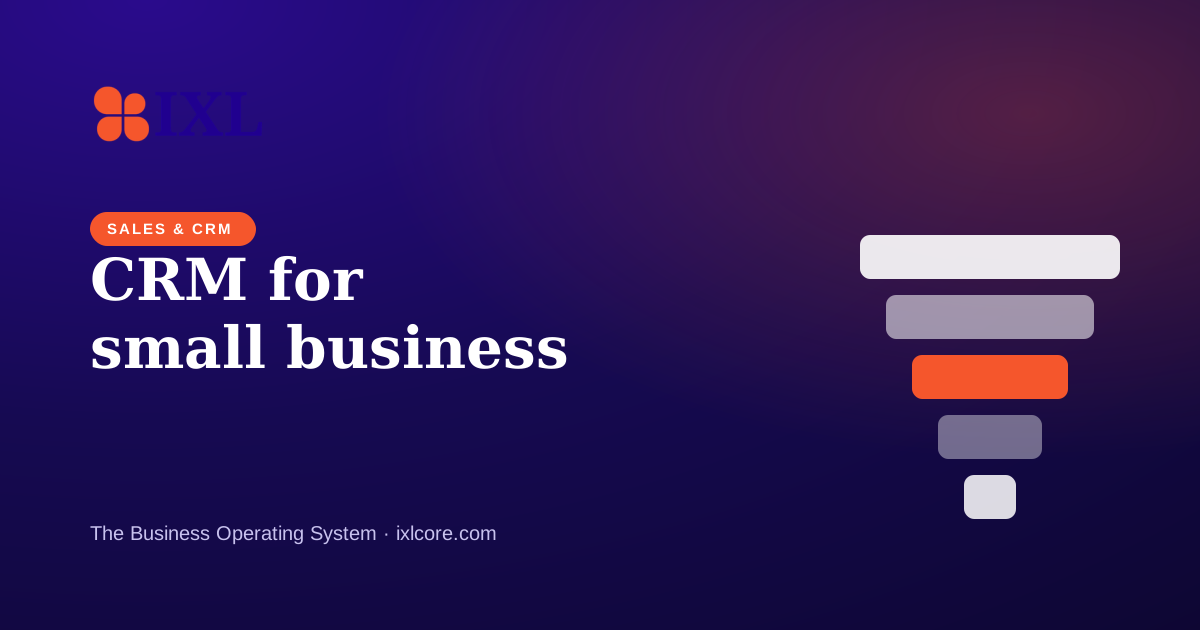
A pipeline is simply your sales process broken into visible stages. A typical one runs something like: New lead → Contacted → Qualified → Quoted → Negotiation → Won (or Lost). Every opportunity sits in exactly one stage, and moves forward as it progresses.
Why visibility matters
When every deal is on a board you can see, the vague question “how are sales going?” becomes a concrete answer. You can see how many deals are at each stage, what they’re worth, and which ones are likely to close soon. That lets you forecast instead of guess, and it tells you where the team’s effort should go.
Spotting stuck deals
Visibility also surfaces problems. A deal that’s been sitting in “Quoted” for three weeks is a signal — the customer went quiet, the price needs a conversation, or someone forgot to chase. Without a pipeline, that deal just quietly dies. With one, it’s obvious, and someone can act before it’s lost.
Follow-up and retention: where the money actually is
There’s an old sales truth: the fortune is in the follow-up. Most deals aren’t won on first contact — they’re won by the business that stayed in touch consistently while competitors gave up after one try. A CRM makes that consistency automatic rather than heroic.
Keep existing customers, not just new ones
It’s far cheaper to keep a customer than to win a new one. Your existing customers already trust you, already know how you work, and are far more likely to buy again — if you stay on their radar.
This is where the full history and segmentation pay off. Because the CRM knows what each customer bought and when, you can prompt a timely check-in, a renewal reminder, or a relevant offer. Retention stops being an afterthought and becomes a deliberate, repeatable habit — and repeat business is the quiet engine of most healthy SMEs.
Why a standalone CRM is only half the answer
Here’s the trap many small businesses fall into: they buy a CRM, tidy up their sales process, and then hit a wall the moment a deal is won. Because the CRM sits on its own, someone has to re-key that won deal into a separate accounting tool to raise a quote or invoice, then into another system to arrange delivery or fulfilment.
Every one of those hand-offs is a chance for something to go wrong — a wrong figure typed, a delivery that never gets scheduled, a customer who’s been invoiced but not served. The sales team thinks the job is done; operations never got the message. This is the gap between “sold” and “delivered”, and it’s where a lot of goodwill quietly leaks away.
The real value of customer relationship management shows up when the CRM connects to the rest of the business. When a won deal flows straight into quoting, invoicing and delivery on one shared source of truth, nothing gets re-keyed and nothing falls between sales and fulfilment. The customer data captured during the sale carries through to the invoice and the delivery note automatically. That’s the difference between a CRM that files your contacts and one that actually runs your revenue.
How to adopt a CRM successfully
The best CRM is the one your team actually uses. Plenty of small businesses buy good software and get nothing from it because adoption fails. A few principles keep that from happening.
Keep it simple
Start with the stages and fields you genuinely need — capture leads, run a pipeline, log follow-ups. Resist the urge to configure every possible feature on day one. A simple system that gets used beats a sophisticated one that gets abandoned.
Get the team to actually log activity
A CRM is only as good as the information in it. Make logging calls, notes and next steps a normal part of the daily routine, not a chore done at month-end. Lead by example — when managers run their meetings off the CRM, the team keeps it current, because it’s now the place where work really happens.
Keep the data clean
Agree on simple conventions: one record per customer, consistent naming, no duplicates. Assign someone to keep it tidy. Clean customer data is what makes reporting trustworthy and follow-ups reliable — messy data quietly erodes confidence until people stop trusting the system at all.
Bringing it together
A CRM for small business isn’t about software for its own sake. It’s about making sure no lead is forgotten, every follow-up happens, and the knowledge of your customers belongs to the business rather than to whoever happens to remember. Done well, it turns a pile of contacts into a managed pipeline, and a managed pipeline into loyal, repeat customers.
The final piece is connection. A CRM delivers its full value when it isn’t an island — when a won deal flows straight into invoicing and delivery without anyone re-typing a thing. That’s the thinking behind IXL CORE: sales, finance and operations on one connected platform, so the relationship you build in the CRM carries all the way through to a job well delivered.